
Sanitizer procurement can appear straightforward until a business needs regular quantities across offices, institutions, hospitality properties, healthcare environments, retail operations, or facility management contracts.
At that point, selecting a Sanitizer Manufacturer becomes a procurement decision involving product information, packaging, intended application, storage, and supply consistency.
Begin With Intended Use
The word sanitizer can be used broadly in the marketplace, so buyers should first identify the exact intended application.
Is the requirement related to hand hygiene, a specific surface application, or another cleaning protocol?
Products should be selected and used according to their labelled purpose and applicable requirements. A product intended for one use should not automatically be substituted for another.
Review Product Information Carefully
Professional procurement teams should look beyond front-label claims.
Depending on the product, useful information can include:
- Intended application
- Directions for use
- Ingredient or composition information where provided
- Handling precautions
- Storage instructions
- Batch information
- Manufacturing details
- Shelf-life information
Commercial buyers should request relevant documentation when required by their organisation or sector.
Packaging Should Match Consumption
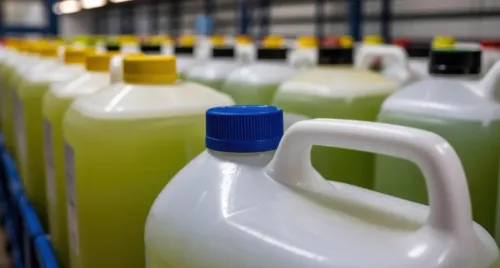
Pack size influences both operating convenience and inventory management.
Small bottles may be appropriate for individual points of use. Larger containers can make sense where central stores refill dispensers across a property.
However, bulk packs require disciplined transfer and labelling procedures.
A facility should know approximately how much sanitizer it consumes before choosing pack sizes.
Estimate Monthly Demand
Businesses can establish a simple baseline by recording:
- Number of dispensing points
- Average refill frequency
- Quantity per refill
- Number of operational days
This provides an approximate monthly requirement.
Procurement can then maintain sensible buffer stock without purchasing excessive inventory.
Check Storage Arrangements
Cleaning and hygiene products should be stored according to the manufacturer's instructions and applicable safety practices.
Storage planning is especially important for businesses purchasing larger volumes.
Consider access control, ventilation requirements where relevant, temperature conditions, segregation from incompatible materials, and stock rotation.
Assess Supply Reliability
A good commercial arrangement needs more than an acceptable first order.
Ask how repeat requirements are handled and whether commonly needed pack sizes are regularly available.
For distributors and cleaning material dealers, continuity becomes even more important because their own customers depend on replenishment.
Pune and Maharashtra Procurement Context
Pune's business environment includes IT campuses, hotels, restaurants, hospitals, manufacturing operations, educational institutions, facility management companies, retailers, and commercial establishments.
Demand can therefore range from individual business consumption to distributor-level purchasing.
ROHO CARE PVT. LTD operates in the cleaning and hygiene products manufacturing segment in Pune. Buyers assessing the company can consider product suitability, documentation, packaging choices, order capability, and commercial support as part of a broader manufacturer comparison.
Avoid Procurement Based on Claims Alone
A professional buyer should be cautious about vague claims that are not supported by clear product information.
Instead, evaluate whether the manufacturer communicates precisely about what the product is intended to do and how it should be used.
A useful evaluation checklist includes:
- Is the intended application clear?
- Are directions understandable?
- Is packaging suitable?
- Can required quantities be supplied?
- Is storage manageable?
- Is relevant product information available?
- Does the procurement model fit recurring demand?
Commercial hygiene procurement works best when product selection and operational planning happen together.
The objective is not simply to keep containers in stock. It is to ensure that the right product is available, appropriately stored, correctly used, and consistently replenished wherever the organisation requires it.
Keywords